ESSAYS ON ROMAN CLASSICAL RELIGION
Find useful resources on the ancestral religion.
Practical Guide of the Cultor Deorum
How to start practicing Cultus Deorum (Cult of the Gods) ?Pax Deorum (Peace of the Gods)The Pax Deorum, or ,,Peace of the Gods’’ is the cosmic order, the completion and the Harmony of the Immortals. It refers to the idea that the Gods constitute the entire universe, and that everything we enjoy comes from them.
The Gods provide, they are order, they are perfection. We thank the Gods for their order, the very fact that the universe is held in its socket, and doesnt ,,fall in the abyss’’ so to say, the fact that everything stays in place and in balance, things we tend to take for granted, like the skies and seas, we owe them tot he Gods. Our practice is to thank them, and worship them for all these things.The Pax Deorum is not only the order of the Gods towards the Cosmos, but also the order between the mortals and the Immortals. We pray to the Gods regularly, and make them offerings, as an active practice that maintains a ,,contract’’ to have their favour. This is called ,,orthopraxy’’ or the ,,correct practice’’.OrthopraxyOrthopraxy, the correct practice, is the opposite of orthodoxy (correct thought) which is the credo of, for example, abrahamic religions, in which faith is enough to call oneself a devotee. Orthopraxy means a devotee constantly maintains a contract, practice defines faith.Being a ,,cultor/cultrix Deorum’’ means celebrating the festivals, the days in honour of the Gods above.Mos Maiorum,,Mos Maiorum’’ means ,,the path of the ancestors’’. It is about honouring the Gods in the ways and customs of our ancestors, in this case, the Roman way, by celebrating the same feriae. (Saturnalia, Lupercalia, Veneralia, etc.)It also means honouring the ancestors, by praying to them and making them offerings, the same way we pray to the Gods.Domestic cultThe domestic cult is the worship of the Lares, Penates, Manes, and geniuses (local spirits, domestic deities, ancestors), which is also practiced with rituals and offerings.
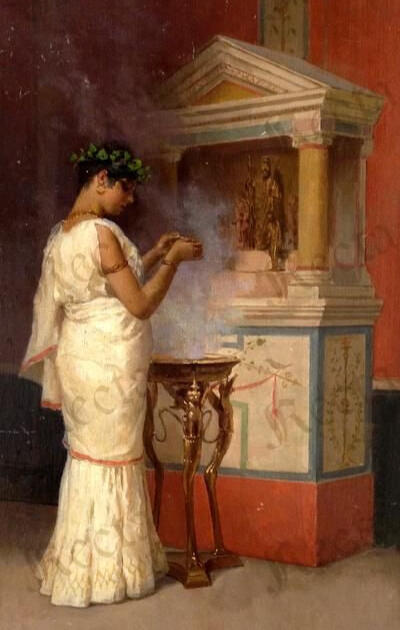
The practice of domestic cult is centered around one space : the Lararium.The lararium is a home altar to the Lares (household Gods and spirits), the Penates (Family Gods and spirits), the Dii Manes (divine ancestors), the genius (spirit) of the home, the genius of the paterfamilias (Father of the household) or the Iuno (spirit, feminine) of the materfamilias (Mother of the household), as well as the genius or the iuno of yourself. Your own, individual genius (m) or iuno (f) is, at the same time, quite your own guardian spirit, a part of your soul, at the same time your guardian, and yourself. You worship Them.The Lararium, more generally your household shrine, is the central piece of your worship, and your religion.Civic cult, public religionReligio Romana values the collective spirit and social life a lot.In Ancient Rome, the civic cult included the cult of the emperors, via the concept of Apotheosis, the divinisation of the emperors.Each Cultor and cultrix of the Gods if free to practice or not the Imperial Cult. Many Roman polytheists consider Imperial Cult a manipulation of the masses, and a gentrification of the divine. Others believe the emperors were appointed by divine providence and made immortal after their deaths.Our temple tolerates both doctrines and does not pronounce itself on this topic as an organisation. Some rare polytheists consider Sol Invictus (or Helios) the King of the Gods, instead of Lord Iuppiter, in a similar fashion, we tolerate both thoughts, but we do pronounce ourselves on the fact that Lord Iuppiter, the Best and Greatest, is King of Gods and Gods of Kings, as ancestral knowledge confirms.How to present oneself before the Immortal Gods ?We are revivalists, we want to revive our ancestral religion, but without illusion that it is frozen in time and should be ,,reenacted’’ like many reconstructionnists do. We do want to be as close as possible to the ancestral practice, we, however, as historians and archaeologists do, lack knowledge of certain aspects of worship, we do not pretend the opposite. This knowledge, we must gain it again, the exact same way our ancestors did, by asking the Gods, by experimenting, and figuring out what the Gods appreciate. In this sense only, we can claim legitimacy of the name of our traditional religion. We always keep ourselves at a good distance from eclectism.Capite VelatoCapite Velato means ,,veiled head’’. We traditionally present ourselves before the Gods with a covered head, no matter the gender. This is to protect ourselves from bad augurs and sights during the invocation, as well as to present a clean energy to the Gods.How to pray to the Gods ?In order to pray to the Immortals, we like to have at least one candle, a container for offerings, a lighter, or matches, one water bowl for ritual washing, and one empty bowl for libations.We use water, occasionally perfumed or with spices, to spiritually wash our hands and face. In hellenic tradition, this purifying water is called ,,khernips’’, and is made by lighting a flame, and extinguishing it in the water while praying tot he Hellenic equivalent of Lady Vesta, Hestia. The candle is used to invoke the deity. We use incense, both as an offering, and to purify the altar. We invoke the Gods because they are not omniscient or omnipresent, they answer when we get their attention.Then, we recite a prayer, usually but not necesseraly in Latin, such as this one ;,, Tum me faciat quod volt magnus Iuppiter ! ‘’Which means,,May the Great Iuppiter do with me as he pleases !’’Prayers can also be improvised, or an improvised prayer can follow a recited one.Offerings include wine, milk, honey, clay effigies of animals, or Libums, ritually cooked cakes for the Gods.As the customs want, we can also offer spices, flowers, and jewellery to the Immortals.The words we want to open and close a prayer are :It is common to recite or sing for the Gods, poems or devotional songs, and Homeric or Orphic Hymns.In Latin tradition, it is important that we do not pray to the Gods while having recently eaten meat, during the day, for eating meat is being in contact with death, especially for important festivals.Neither do we show up to the altar after having had sex, or with a dirty body, or dirty clothes.Is it possible to believe in the deities of many pantheons at the same time ?Yes, this is what is known as syncretism; we do this with all polytheistic religions. We regard each polytheistic religion as embodying aspects of the Gods—the same Gods with different names.Historically, the Romans encountered foreign gods for whom they had no equivalent. Through liturgical wisdom, they incorporated these gods into the Roman pantheon. This includes, notably, Isis, Mithras, and Serapis.It is the role of each individual, through prayer, faith and virtue, to learn more about the divine, in order to honour it more fully. This is a spiritual and personal path that we encourage.That said, our temple focuses on Greco-Roman practice, which means that we worship the Roman gods and, additionally, follow the Hellenic tradition, although we adhere to the Roman calendar.Everyone is free to join our organisation just as they are free to leave it, and free to practise any tradition.Finally, we assist in the Roman practice, the Roman path to the Gods.Can I practice if I do not come from Italy or a Latin country ?Yes, absolutely; Roman polytheism is no more an ethnic religion than our organisation is folkist. In antiquity, the entire Roman world practised the Roman way of worshipping the gods, from Caledonia to Persia (present-day Scotland to present-day Iran).Can I practice Roman Religion if I belong to a sexual minority ?Yes : Roman polytheism, the Gods, and our temple do not condemn any sexual practice that is explicitly consensual between two adults capable of giving consent, and which does not infringe upon the physical or moral integrity of the individuals involved.How do I choose which Gods to worship ?This choice is up to the devotee; it depends entirely on their spiritual path. No one should impose it, and no one should judge it.What is the pomerium?The pomerium marks the boundary, primarily between the city and its outskirts. This rarely affects the average devotee, but rather the soldier-devotee and the architect-devotee, in the sense that, in the Religio Romana, armed soldiers do not station themselves within the city, the dead are not buried within the city, and temples to the martial and chthonic Gods are not built within the city.If we wish to address this concept in a way that is particularly relevant today, we would speak specifically of the boundary between the mundane and the divine, that is, that which is intended for mortals, and that which is intended for immortals.What are the values of the Religio Romana ?The most important ones are:Pietas (piety), which is the act of devoting oneself to the worship of the Immortals out of duty and with rigour, in order to contribute to the cosmic order.
It is also the act of honouring one’s family and what the Gods bestow upon us. Pietas, in fact, is by far the most important of virtues, and by nature, encompasses the others. Pietas is a duty to one's fatherland, one's family, ancestors, and the Gods.
The holiness of the state of Rome, and how central it was to our religion, makes a cultor or cultrix of the Gods kind of a binational. For example, if you are an italian, or a french, or a spanish, you have a duty to your Fatherland that is modern Italy, France, or Spain. But you are, say, a spanish, before you are a roman.Virtus (virtue), meaning being responsible, doing what is right, being steadfast, and acting justly. It also means presenting the best version of oneself before the Gods—an excellent version that does not lie and keeps its promises.Gravitas (seriousness), that is, showing formality before the Gods, not joking, and not treating prayer as something trivial.Fides (loyalty), meaning keeping one’s promises, and not making them lightly; indeed, if possible, avoiding making them altogether. It is being someone on whom others can rely.Constantia (steadfastness), meaning remaining devout over the long term, even when things go wrong.Dignitas (dignity), meaning living well, behaving decently towards others, taking care of one’s home, and giving so that we may receive in return.
How to start practicing Cultus Deorum (Cult of the Gods) ?Pax Deorum (Peace of the Gods)The Pax Deorum, or ,,Peace of the Gods’’ is the cosmic order, the completion and the harmony of the Immortals. It refers to the idea that the Gods constitute the entire universe, and that everything we enjoy comes from them. The Gods provide, they are order, they are perfection. We thank the Gods for their order, the very fact that the universe is held in its socket, and doesnt ,,fall in the abyss’’ so to say, the fact that everything stays in place and in balance, things we tend to take for granted, like the skies and seas, we owe them tot he Gods. Our practice is to thank them, and worship them for all these things.The Pax Deorum is not only the order of the Gods towards the Cosmos, but also the order between the mortals and the Immortals. We pray to the Gods regularly, and make them offerings, as an active practice that maintains a ,,contract’’ to have their favour. This is called ,,orthopraxy’’ or the ,,correct practice’’.OrthopraxyOrthopraxy, the correct practice, is the opposite of orthodoxy (correct thought) which is the credo of, for example, abrahamic religions, in which faith is enough to call oneself a devotee. Orthopraxy means a devotee constantly maintains a contract, practice defines faith.Being a ,,cultor/cultrix Deorum’’ means celebrating the festivals, the days in honour of the Gods above.Mos Maiorum,,Mos Maiorum’’ means ,,the path of the ancestors’’. It is about honouring the Gods in the ways and customs of our ancestors, in this case, the Roman way, by celebrating the same feriae. (Saturnalia, Lupercalia, Veneralia, etc.)It also means honouring the ancestors, by praying to them and making them offerings, the same way we pray to the Gods.Domestic cultThe domestic cult is the worship of the Lares, Penates, Manes, and geniuses (local spirits, domestic deities, ancestors), which is also practiced with rituals and offerings.Civic cult, public religionReligio Romana values the collective spirit and social life a lot.In Ancient Rome, the civic cult included the cult of the emperors, via the concept of Apotheosis, the divinisation of the emperors.Each Cultor and cultrix of the Gods if free to practice or not the Imperial Cult. Many Roman polytheists consider Imperial Cult a manipulation of the masses, and a gentrification of the divine. Others believe the emperors were appointed by divine providence and made immortal after their deaths.Our temple tolerates both doctrines and does not pronounce itself on this topic as an organisation. Some rare polytheists consider Sol Invictus (or Helios) the King of the Gods, instead of Lord Iuppiter, in a similar fashion, we tolerate both thoughts, but we do pronounce ourselves on the fact that Lord Iuppiter, the Best and Greatest, is King of Gods and Gods of Kings, as ancestral knowledge confirms.How to present oneself before the Immortal Gods ?We are revivalists, we want to revive our ancestral religion, but without illusion that it is frozen in time and should be ,,reenacted’’ like many reconstructionnists do. We do want to be as close as possible to the ancestral practice, we, however, as historians and archaeologists do, lack knowledge of certain aspects of worship, we do not pretend the opposite. This knowledge, we must gain it again, the exact same way our ancestors did, by asking the Gods, by experimenting, and figuring out what the Gods appreciate. In this sense only, we can claim legitimacy of the name of our traditional religion. We always keep ourselves at a good distance from eclectism.Capite VelatoCapite Velato means ,,veiled head’’. We traditionally present ourselves before the Gods with a covered head, no matter the gender. This is to protect ourselves from bad augurs and sights during the invocation, as well as to present a clean energy to the Gods.How to pray to the Gods ?In order to pray to the Immortals, we like to have at least one candle, a container for offerings, a lighter, or matches, one water bowl for ritual washing, and one empty bowl for libations.We use water, occasionally perfumed or with spices, to spiritually wash our hands and face. In hellenic tradition, this purifying water is called ,,khernips’’, and is made by lighting a flame, and extinguishing it in the water while praying tot he Hellenic equivalent of Lady Vesta, Hestia. The candle is used to invoke the deity. We use incense, both as an offering, and to purify the altar. We invoke the Gods because they are not omniscient or omnipresent, they answer when we get their attention.Then, we recite a prayer, usually but not necesseraly in Latin, such as this one ;,, Tum me faciat quod volt magnus Iuppiter ! ‘’Which means,,May the Great Iuppiter do with me as he pleases !’’Prayers can also be improvised, or an improvised prayer can follow a recited one.Offerings include wine, milk, honey, clay effigies of animals, or Libums, ritually cooked cakes for the Gods.As the customs want, we can also offer spices, flowers, and jewellery to the Immortals.The words we want to open and close a prayer are :It is common to recite or sing for the Gods, poems or devotional songs, and Homeric or Orphic Hymns.In Latin tradition, it is important that we do not pray to the Gods while having recently eaten meat, during the day, for eating meat is being in contact with death, especially for important festivals.Neither do we show up to the altar after having had sex, or with a dirty body, or dirty clothes.Is it possible to believe in the deities of many pantheons at the same time ?Yes, this is what is known as syncretism; we do this with all polytheistic religions. We regard each polytheistic religion as embodying aspects of the Gods—the same Gods with different names.Historically, the Romans encountered foreign gods for whom they had no equivalent. Through liturgical wisdom, they incorporated these gods into the Roman pantheon. This includes, notably, Isis, Mithras, and Serapis.It is the role of each individual, through prayer, faith and virtue, to learn more about the divine, in order to honour it more fully. This is a spiritual and personal path that we encourage.That said, our temple focuses on Greco-Roman practice, which means that we worship the Roman gods and, additionally, follow the Hellenic tradition, although we adhere to the Roman calendar.Everyone is free to join our organisation just as they are free to leave it, and free to practise any tradition.Finally, we assist in the Roman practice, the Roman path to the Gods.Can I practice if I do not come from Italy or a Latin country ?Yes, absolutely; Roman polytheism is no more an ethnic religion than our organisation is folkist. In antiquity, the entire Roman world practised the Roman way of worshipping the gods, from Caledonia to Persia (present-day Scotland to present-day Iran).Can I practice Roman Religion if I belong to a sexual minority ?Yes, absolutely: Roman polytheism, the gods, and our temple do not condemn any sexual practice that is explicitly consensual between two adults capable of giving consent, and which does not infringe upon the physical or moral integrity of the individuals involved.How do I choose which Gods to worship ?This choice is up to the devotee; it depends entirely on their spiritual path. No one should impose it, and no one should judge it.What is the pomerium?The pomerium marks the boundary, primarily between the city and its outskirts. This rarely affects the average devotee, but rather the soldier-devotee and the architect-devotee, in the sense that, in the Religio Romana, armed soldiers do not station themselves within the city, the dead are not buried within the city, and temples to the martial and chthonic Gods are not built within the city.If we wish to address this concept in a way that is particularly relevant today, we would speak specifically of the boundary between the mundane and the divine, that is, that which is intended for mortals, and that which is intended for immortals.What are the values of the Religio Romana ?The most important ones are:Pietas (piety), which is the act of devoting oneself to the worship of the immortals out of duty and with rigour, in order to contribute to the cosmic order. It is also the act of honouring one’s family and what the Gods bestow upon us.Virtus (virtue), meaning being responsible, doing what is right, being steadfast, and acting justly. It also means presenting the best version of oneself before the Gods—an excellent version that does not lie and keeps its promises.Gravitas (seriousness), that is, showing formality before the Gods, not joking, and not treating prayer as something trivial.Fides (loyalty), meaning keeping one’s promises, and not making them lightly; indeed, if possible, avoiding making them altogether. It is being someone on whom others can rely.Constantia (steadfastness), meaning remaining devout over the long term, even when things go wrong.Dignitas (dignity), meaning living well, behaving decently towards others, taking care of one’s home, and giving so that we may receive in return.
Process of a Roman Ritual
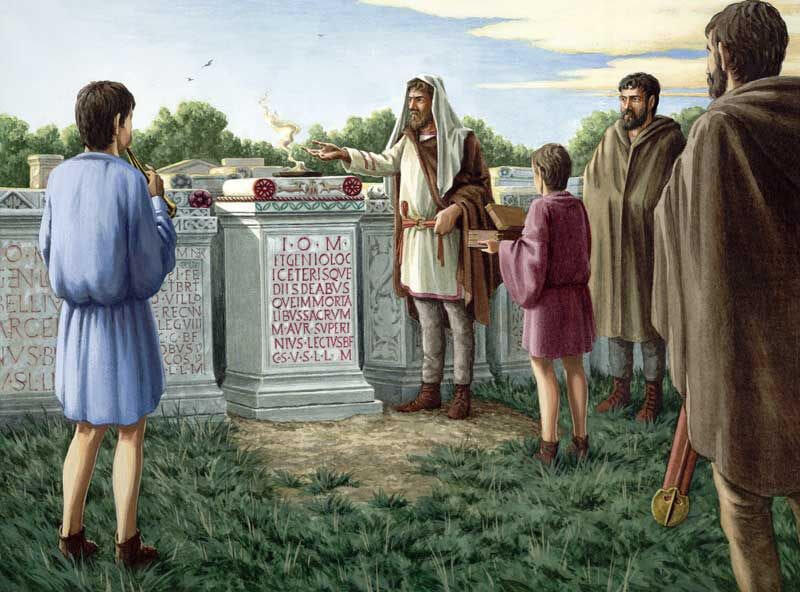
The process of a Roman prayerNote 1: This corresponds to a reconstructionist/revivalist practice, closely aligned with ancient practice and the Mos Maiorum. Prayer is practised in particular during festivals, which are of great importance to the Religio Romana. It is also practised to make a request, to work with the deity or deities, to honour them, and to make offerings to them. The Romans of antiquity practised religion as something very contractual; we recommend a practice that moves away from reconstructionism and towards revivalism, praying to the Gods when one feels the need or desire to do so, to speak to them, and to seek a kind of closeness with them, which is similar to Hellenic practice, with ‘kharis’ – that is, a bond with the Gods. We recommend formal prayer during events, and more spontaneous prayer outside of them.Note 2: Another very interesting aspect of Hellenic practice is the importance of sound and poetry. We offer to the Gods what is beautiful and what is good, as well as what is of value, what has taken time, and what comes from the heart. We also recommend offering spontaneous prayers, akin to meditation, to draw closer to the Gods. Whilst the invocation may be formal, and the request so too, the exchange with the divine must be explored in a manner that suits the devotee, arising from their individual spiritual quest.Note 3: In Ancient Rome and Ancient Greece, animal sacrifices were rare public ceremonies; they were precious occasions where animals of great value were offered to the Gods. It was not something done regularly, or at home. Often, when performing rituals involving animal sacrifices , clay effigies of the animals were sacrificed instead.Since public festivals in our religion are extremely rare, we recommend doing the same, by creating clay effigies and then burning them.In general, we strongly advise against animal sacrifice.In ancient times, the purpose of animal sacrifice was to offer the fat and bones to the gods by burning them, and then to eat the meat.
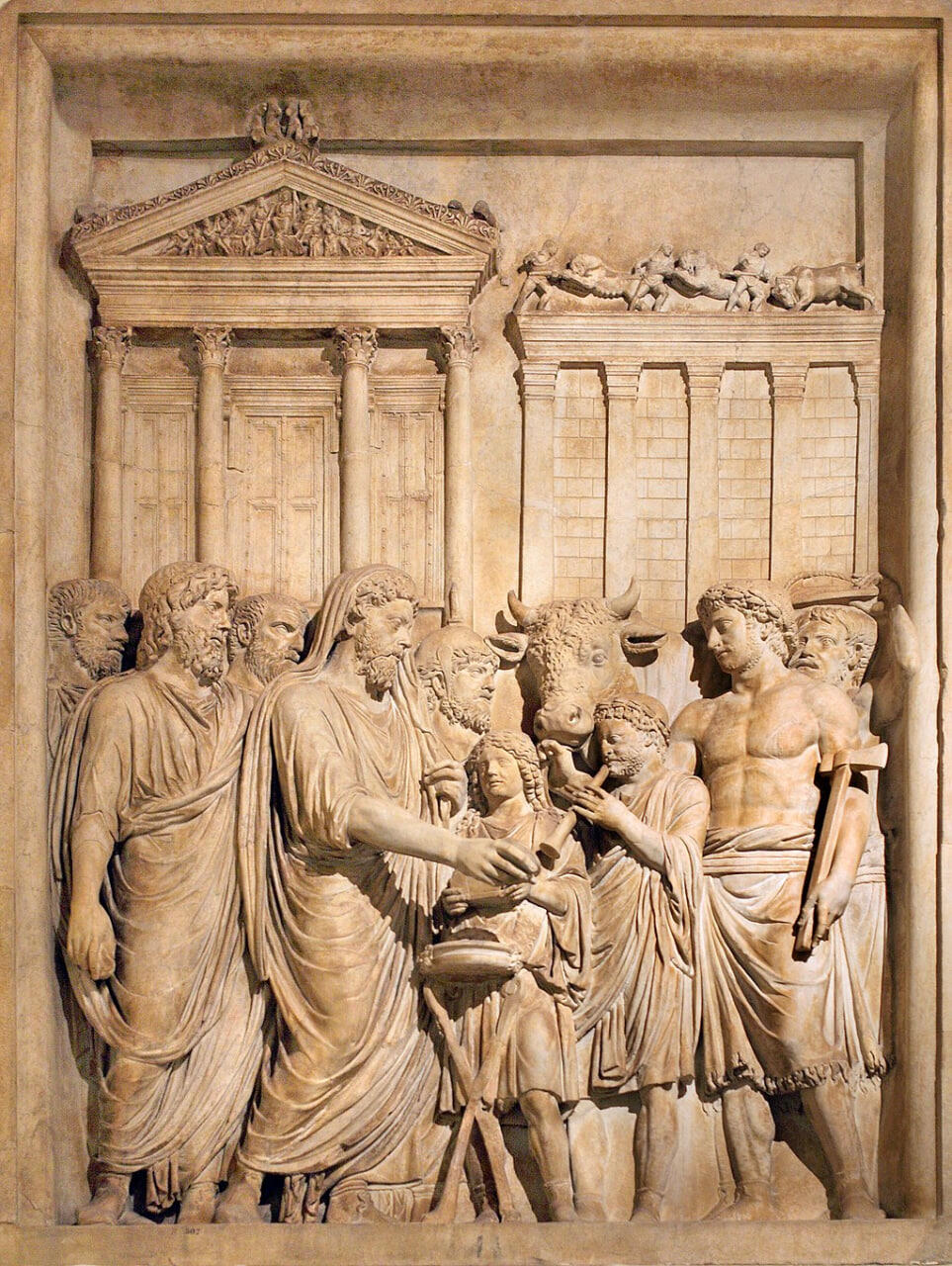
RitualPrayer performed, if possible, facing east, with the altar facing west, and in Capite Velato (veiled head) for all genders,Purificatio (washing one’s hands and face with ritual water, covering oneself with a ritual veil). First we invoke Father Janus (Ianus), asking Him to open the Gates of Heavens, of which He is, among other domains, the patron. Then Mother Vesta is invoked, for purification, we ask Her to purify our substance as from lead to gold, and our body and soul, the way rain washes the air. To Ianus and Vesta we offer incense, myrrh or frankincense ideally, in sincere hope that our prayers will be fulfilled.
In itself, this prayer is a ritual, so, when rightly performed, we close it with saying "Ita est", Latin for "it is so". Then we turn round to signify the circular nature of the World and how our purpose in the universe is fulfilled by propitiating the Immortals. However, this step only ensures the right procedure of the whole.Invocatio (Greet the deity or deities with the appropriate epithets, tap the altar to attract their attention.Adoratio
Light the candles/lucernae (oil lamps). Of course, this starts with Ianus' flame, then follows Vesta's. All the other flames are not lit individually from the lighter or matches, but each flame is lit from Ianus' flame. Turn once on one’s heel and/or walk twice around the altar, kiss one’s hand, and send the kiss to the deity or deities being prayed to (towards the Heavens if celestial, towards the ground if chthonic, towards water or the altar if a water deity) generally, wherever one feels the deity’s presence.
This is done with one hand touching the altar. In Roman Gaul, the opposite was practiced, sending a kiss with the left hand, whilst the right hand rested on the altar.If one is praying to a celestial deity and a chthonic deity at the same time, (for example, celestial Venus and then psychopomp, chtonic Mercurius), then direct your hands towards the Heavens while invoking Mother Venus' name, and towards the ground when invoking Lord Mercurius. (Note : Mercurius is prayed to as chtonic only in His psychopomp aspect.)Prex
A recited prayer, followed by a potential improvised prayer.
You can learn by heart a historical prayer, hymn, or quote from a book (typically Homeric or Orphic Hymns, or the Aeneid, the Bacchae, the Theogony, the Iliad or Odyssey.)
Also, this is when you talk with an open heart to the deities you invoke.Sacrificium:
The classical Roman religion regards offerings as a culture, "do ut des" is very important, it means "I give so that you may give". It is not transactional, you build with the Gods what the Greeks called kharis. The Immortals give us everything we have, and without Them, we would have nothing, be nothing. So, we give Them back some of what we have, to acknowledge that it is not granted, and to thank Them for providing so much. Furthermore, we propitiate Them to be in their favours, when we need something, and to appease Them.
Things have a life, at the end of it, they go back to the Gods, all things partake in the greater cycle of life, and therefore, in cosmic order. Thus, making an offering means shortening the life of an object, to bring it back to the Immortals.Offerings are given to the deity or deities. Usually, we give wine to male deities and milk to female deities, honey for both. (burned or poured) With wine, red is prominent, diluted with water and spiced, poured with honey, but not necessarily. The wine must not be diluted if we are giving it to a chtonic deity.
A traditional offering of libum (roman bread-like cheesecake) is always great. When celebrating in private a public festival where animal sacrifice was of use in Ancient Rome, wisest is, if not possible to observe such a sacrifice, to create a clay figure of the animal, and burn it.Immolatio: the offering of a libation or sacrifice.Redditio: offering of gifts promised to the Gods.Miscellaneous (music, singing, hymns/carmina, dances, etc.)Piaculum
During a roman ritual, correct practice is very important. Sometimes, especially in the beginning, you make mistakes, and sometimes, you don't notice them.
So, at the end of every prayer, you apologise if any mistake was done, you specify that it was not out of malice, but out of ignorance.Again, you conclude by ‘Ita est’. You turn round again.After lighting off the candles or lucernae, you take down your veil, and sit down, to manifest the prayer.